Not your keys, not your songs
Last rites for Nina Protocol
Summary
- Nina Protocol, a VC-backed web3 music startup, promised to compensate artists, change music discovery, and make independent music hosting permanent and independent.
- It’s understood that they failed on these counts, but the magnitude of that failure has been underestimated: only about $50,000 was spent on Nina throughout the platform's lifetime, with the vast majority of releases going uncollected.
- Nina ultimately failed to articulate (or realize) an alternative to Bandcamp or Spotify. Others may manage.
Update (7/14/26): After publication, we learned that when Nina Protocol migrated to a new on-chain protocol in 2025, approximately 6,500 early releases were dropped from its web catalogue and left stranded on Solana, unavailable for purchase. We’ve updated all-time spending figures with records from the blockchain.
No one had been anxiously anticipating the moment we’d finally be able to collect and sell digital music via decentralized ledgers. But for a moment in the 2020s, when VCs were throwing good money after bad in hopes of convincing us that we’d been waiting for web3 all along, the music platform Nina Protocol could make the case that cryptocurrency-powered music hosting would upend the economics of music streaming and lend the recordings themselves a permanence beyond corporate entities. Even if Nina died, the music would live on the blockchain forever.
Today, their site uses a few different euphemisms — it is an “offramp,” they are “winding down” — but what they really mean to tell you is that it's all over. Two days after Components started researching this piece, Nina Protocol’s web catalogue was shut down. Next Wednesday, the website will go offline. When that happens, it will be as if Nina never existed at all.
For the uninitiated, Nina was an online music marketplace founded in 2021 by a few indie lifers. This alone would put it in the company of about a dozen Bandcamp clones, but for one very special difference: Nina was built on the blockchain platform Solana, which meant that in the early 2020s web3 hype cycle, it could attract a round of seed funding from five co-investors and end up in the portfolio of Greenfield Capital, where it sat between world-beaters like “a liquidity aggregator connecting multiple decentralized exchanges” and “the company behind CryptoKitties.” PitchBook supplies no dollar figure, but given that they operated for nearly four years post-raise with a handful of full-time staff and no profits, it’s hard to imagine a number under seven figures.
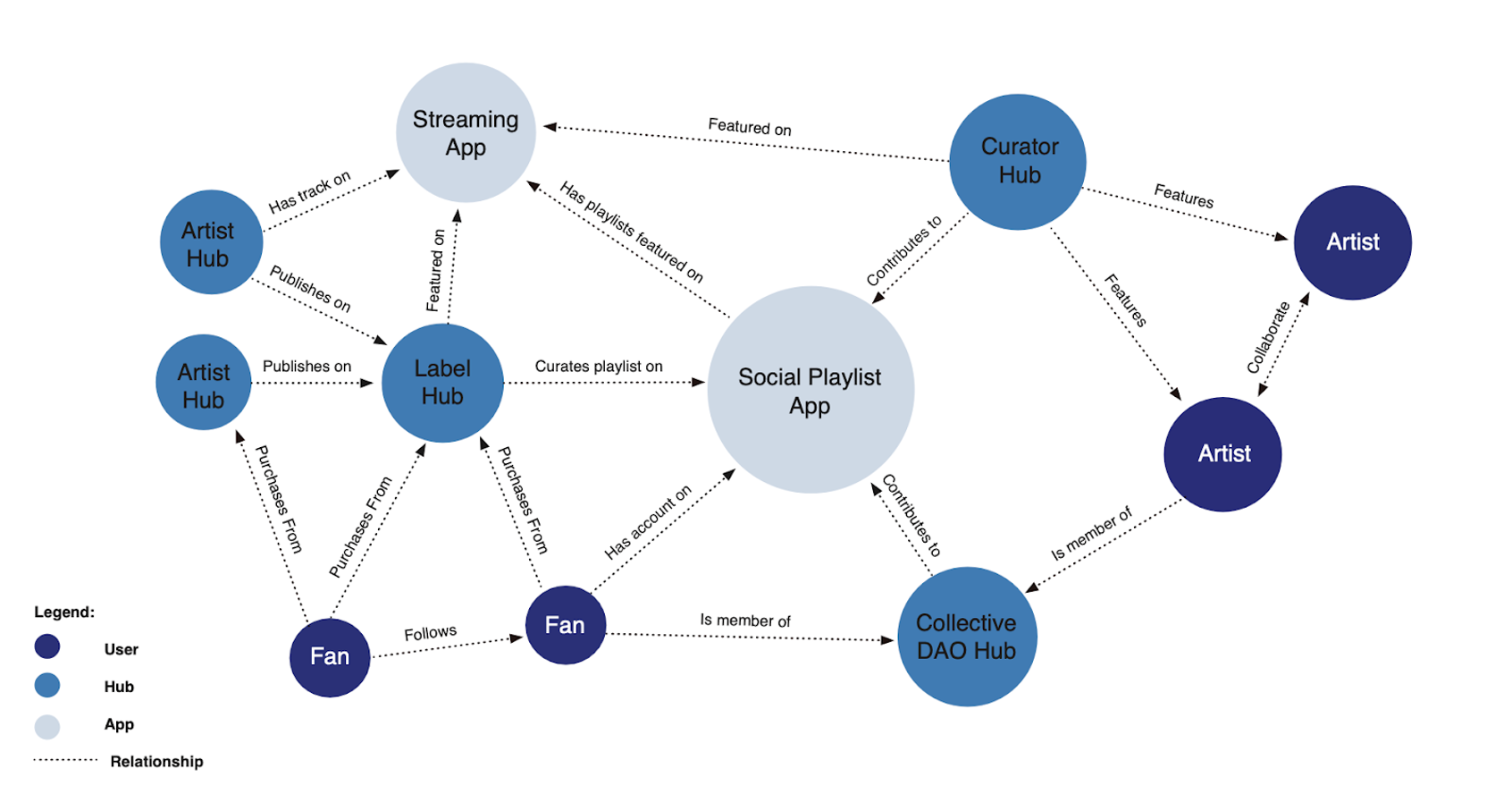
In early interviews, Nina’s founders would set out their mission to “ascribe value to digital music in an entirely new way.” You could be forgiven for not seeing why cryptocurrency was an essential part of this formulation; if to sign with a label is to swim through a sixty-yard trench of shit, then the mechanics of on-chain listenership and distribution amounted to a backstroke in the opposite direction. All payments might go to the artist on Nina, but the artist would be saddled with publishing fees contingent on the vagaries of Solana’s market. Listeners would need to manage a Solana wallet and the accompanying microtransactions or, in the case of the “first collector,” cover upfront hosting costs in exchange for a cut of future fees.
Why bother? Greenfield's argument for web3 in music was essentially that it could function as a goodie bag delivery mechanism (complete with “token-gated digital experiences” and “tangible fan services, like exclusive Discord channels with artists or free NFT airdrops”). Nina itself pointed to more highminded ideals (democratization, decentralization). But beneath all this was a familiar promise, the same made by every other Bandcamp alternative: that Nina would bring about a new model for artist compensation, permanent music collection, and discovery sans algorithms: “music online as it should be.”
This did not come to pass. Despite Nina's efforts to “release independent music from the grips of Big Streaming” and the “attention lottery,” demand proved scarce on Nina, and what demand did exist was no more or less concentrated than on any other music platform. What’s remarkable, then, is not just that about 77% of Nina’s roughly 37,000 listings went uncollected, but just how low the ceiling was: if your Nina release was collected just five times, it was sitting at the 97th percentile.
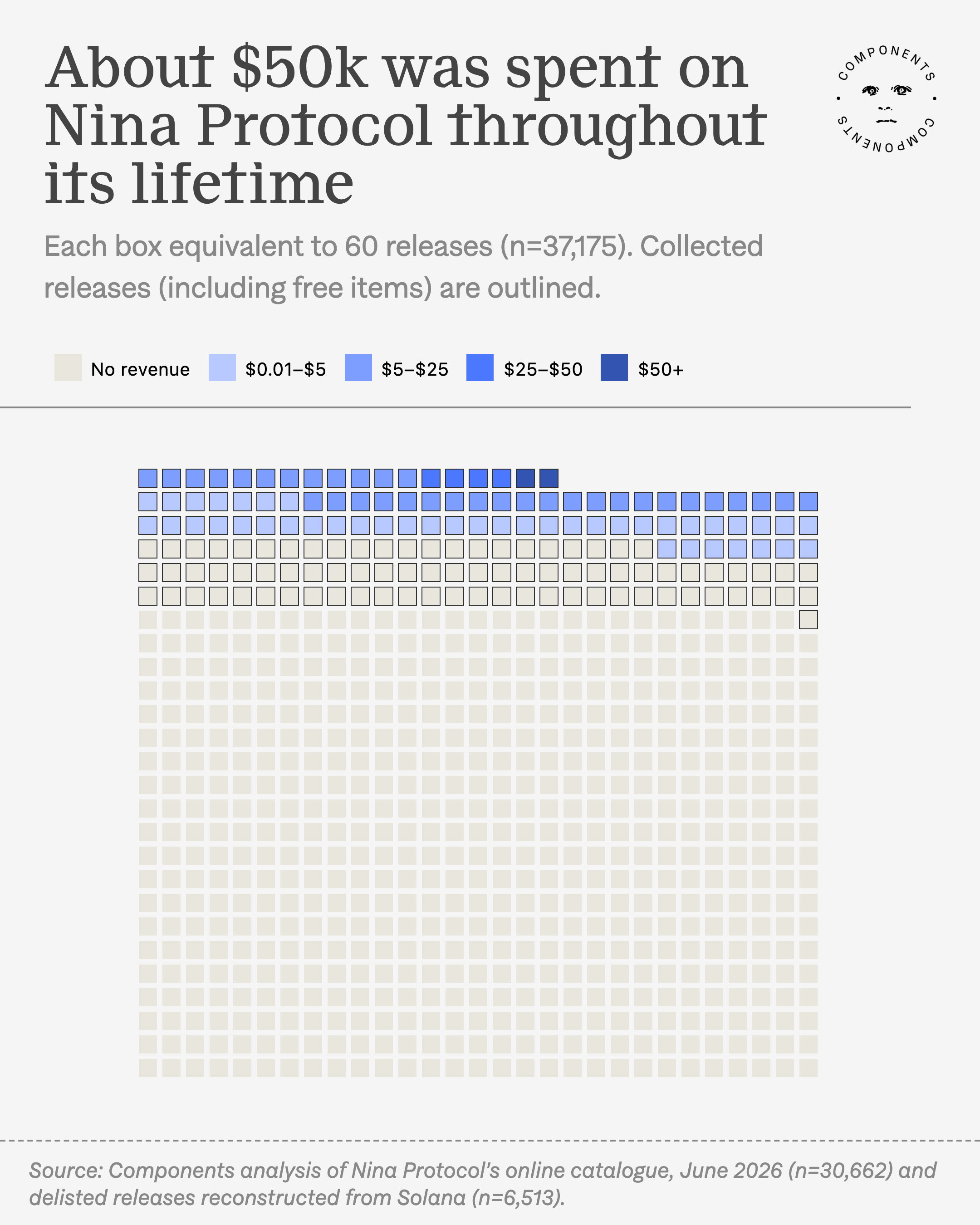
If Nina attracted VC funding with the aim of changing how music was bought and sold forever, then by 2025, they had been cowed into more modest aspirations. One Nina cofounder told Rolling Stone last October that it would be enough “if [they] ever hit ten percent of Bandcamp’s daily volume.” The issue is that Nina failed to clear .01% of Bandcamp’s volume. By our math The number of collectors for each paid release, multiplied by the price of each release, calculated across Nina’s entire catalogue, excluding Community Revenue Share fees. Nina's FAQ states that release prices could not be altered, and makes no mention of pay what you can pricing. For releases that were delisted from Nina’s web catalogue, we’ve drawn spending estimates from Solana. , about $50k was spent on Nina over the course of its lifetime, compared with the $151 million in sales Bandcamp processed in 2025 alone.
And so far as we can tell, Nina earned no money whatsoever from any activity on the platform until October 2025, when a $1 “Community Revenue Share” was tacked onto every transaction — 50¢ of which would go directly to “Nina platform operations.”
The only thing that Nina's Faustian bargain with blockchain would seem to guarantee, then, was permanence: “If we shut down tomorrow, the music would still be there,” Nina’s Mike Pollard told Rolling Stone. He’s right. Every release uploaded to Nina is intact and whole, somewhere out there in an Arweave server. All you need to do is dig their program ID out of their GitHub or a block explorer; run a getProgramAccounts query against that program filtered to accounts where the authority field equals your pubkey (which requires knowing the account's byte layout and the offset where the publisher key sits), which requires you to deserialize with Nina's Anchor IDL from the SDK — and Public RPC endpoints also throttle or disable getProgramAccounts because it's expensive, so you may need a paid node — and then parse out the Arweave pointer each account holds. If you did eventually make your way to your Chanel Beads LP, you'd find it riding out eternity in a tranche with Pudgy Penguins; as Rachel Adjogah noted in a 2025 blog post, Arweave uses Irys to bundle the different NFTs it hosts.
Through all this, Nina had produced one thing which might not revolutionize how people related to music, but which would at least mark a positive project: its editorial wing, which fostered a fairly devoted community. But all the blockchain in the world could not keep this from being shunted into oblivion while the team “looks into [archive] options.”
So, Nina was shuttered for reasons that are not only endemic to the sector (e.g. Juno Download and Resonate's recent closures) but embarrassingly particular to the great DIY-WAGMI mésalliance. For all the insistence on permanent ownership, Nina has left its community out to dry in precisely the same way, and for precisely the same reason, as the numberless dead startups before it: because a small team of people moved on when the salaries ran out. We would stop beating this horse if not for the even more interesting questions raised by this failure.
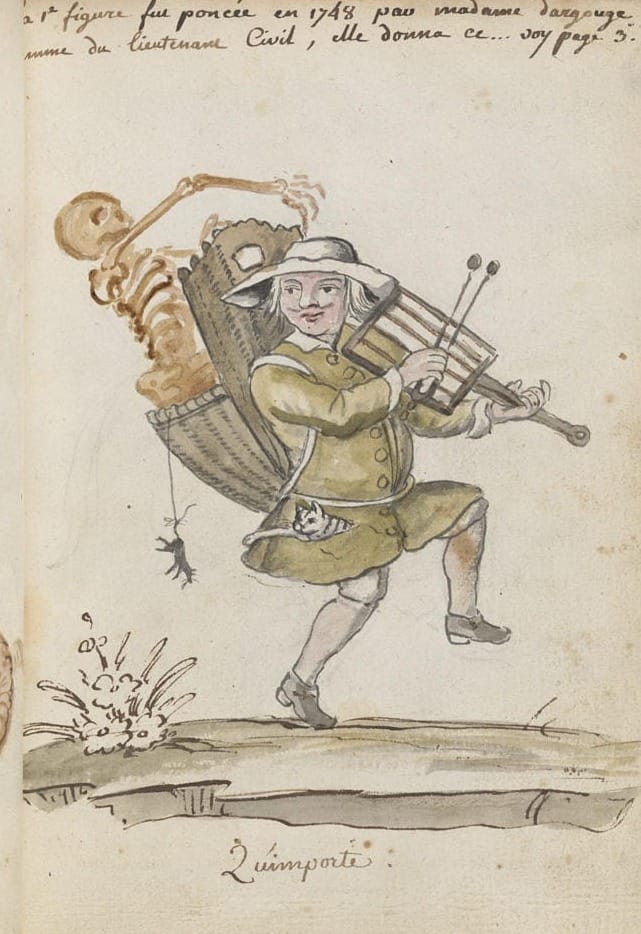
One question is what Greenfield and co. thought they were doing. Did they really think they were investing in the next great American music listening platform? The firm’s own writeup on Nina referred to the platform's NFTs as “one-of-a-kind digital vinyls” (sic), which does not suggest that they did their due diligence (or understood music much at all), but squint and you can see why Nina fit a web3 firm’s thesis: if there were any common ground between the respective fantasies of NFTdom and scenedom, it would be that you and I might charge a finders’ fee for getting there first (as made literal by the First Collector model). It’s trite to point out that crypto was always a play for speculation; obviously it was. More than that, however, it was a cynical assumption that our whole culture was just as speculative as it was.
Another question is what Nina thought it was doing. We know the team operated on investor funding while bringing in zero revenue for the three years prior to the $1 Community Revenue Fee (with which it continued to earn essentially nothing). This suggests that the strategy was to follow in the footsteps of so many startups before them and scale — that is, burn VC cash and draw an audience in hopes of extracting a profit from them later. The boom-bust mentality and reliance on external capital that this engenders is obviously at practical and ideological odds with a stable independent music scene. It is also, incidentally, a description of Spotify’s business model from its founding until two years ago. So while I can’t really fault them for taking money from Palm Tree DAO and using it to bankroll music writers and live nights, it's wholly unsurprising that this failed to reverse the general debasement of music marketplaces or effect any lasting change in the world around them. As the old joke goes: that’s fine and well in practice, but what about the theory?
For all these issues, however, the most puzzling question may be why Nina had to die as any kind of going concern at all. Why they failed as a corporation is obvious. But to answer the Instagram user who commented on their obituary, “can we crowdfund to save nina please we can’t have a platform this good shutting down”: yes, Nina could have been entirely crowdfunded. It’s possible that Nina, at zero revenue after four years, was forced to close so its investors could claim a write-down, against the founders’ wishes. That’s only possible if investors had a majority share of board seats, which would be highly unusual for a seed-stage company. In the unlikely event Nina did give them a majority share of the board, then this was a worse decision than putting the music on Solana. One option would be to jam econo: rip out the web3 wiring, store all the music in Cloudflare R2 buckets, hook up Stripe payments, cancel their salaries, and run the whole thing with some cash from a few Patreon supporters. But then Nina would have found themselves with Bandcamp.
So did even Nina believe Nina was worth sticking out? If you feel the need to take your failing business off life support, that's your prerogative — and to paraphrase another set of New York scenesters, “just because a movement ceases to exist doesn’t mean it was a failure.” But one wonders just how many Bandcamp alternatives will cease to exist before one works.
In the later years, you could sense that the Nina team was a little embarrassed by the crypto millstone around its neck — or could at least see which way the wind was blowing. In 2024, Pollard told an interviewer he felt “the benefits of blockchain [could] be delivered without having to fully drink the Kool-Aid.” A pointed distinction between Nina's “semi-fungible tokens” and NFTs was added to the FAQ. Coindesk got no further interviews. And yet, by dropping its community and calling it a day when the VC money ran dry, Nina proved it could rugpull with the best of them.
But when ninaprotocol.com does go offline next Wednesday, it will leave behind some of the most viable new ways of hearing since Soulseek. On Cantilever, listeners are presented with a rotation of albums, impermanence by design. It brings context not with immutable and inalterable ledgers, but with good old-fashioned editorial. Mirlo has stuck to its open-source commitments and facilitated merch sales while operating as a co-op. Subvert, too, has made it out of the bylaws (and made good on the promise of its $100 zine) with that rarest of things: a functional community-run platform. If we take their homepage’s word for it, then six weeks on from launch, it hosts more artists than Nina did in its lifetime.